
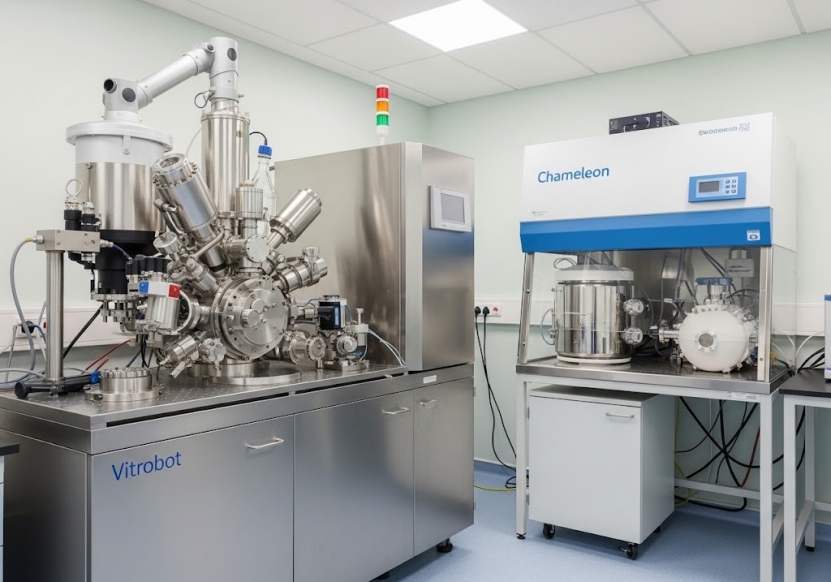
Achieving high-resolution structures of biological macromolecules using Cryo-Electron Microscopy (Cryo-EM) is a powerful technique in modern life science and drug discovery. While advanced microscopes and sophisticated data processing are crucial, the success of a Cryo-EM project often hinges on a fundamental step: sample preparation. Proper sample preparation ensures that biological particles are vitrified in a thin layer of amorphous ice, ideally dispersed and maintaining their native structure, which is essential for subsequent imaging and analysis.
Efficient and reproducible sample vitrification relies on specialized equipment designed to rapidly plunge-freeze the sample, preventing the formation of crystalline ice that would damage the biological structures and obscure structural details. Within the Cryo-EM workflow, automated plunge freezers are key tools for this process.
The sources provided, which describe the services offered by Shuimubio, highlight various aspects of their Cryo-EM offerings and the importance of sample quality and preparation methods.
Sample Preparation in the Shuimubio Cryo-EM Workflow
Shuimubio, founded in 2017, is described as Asia's first commercial platform offering Cryo-EM structural analysis services. They offer a "one-stop" solution from gene sequence to high-precision 3D protein structure, recognizing that successful structure analysis begins with high-quality samples.
Several key services where sample preparation is paramount:
1. "One-stop" SPA Solution (Single Particle Analysis): SPA is a powerful tool for resolving the high-resolution 3D structure of biological macromolecules. It requires purified biological macromolecule particles. The sample requirements for SPA are stringent, specifying protein concentration (≥2mg/mL), volume (≥100ul), and purity (≥90%). Recommendations are also given to minimize glycosylation or phosphorylation modifications and repeated freeze-thaw cycles, ideally using freshly prepared samples. Buffer conditions, such as minimizing organic solvents like glycerol and keeping salt concentrations ≤300mM, are also important.
2. Machine Time Service (24h data collection): Shuimubio provides access to their 300kV Cryo-EM facilities in Beijing and Hangzhou. The description of the machine time service mentions that the experimental process is managed in a closed loop and is equipped with auxiliary equipment such as Vitrobot, surface plasma processors, and other devices. The Vitrobot Cryo-EM plunge freezer is a widely used automated system for preparing Cryo-EM grids. Its inclusion as part of Shuimubio's setup indicates its role in the automated process of vitrifying samples for data collection on their high-end microscopes. Sample requirements for the machine time service emphasize timely delivery of frozen samples (at least one working day in advance), proper packaging (liquid nitrogen tanks), and providing preparation conditions if Shuimubio's platform prepared the grids. Samples should be aliquoted to avoid repeated freeze-thaw cycles.
3. GraFuture™ Technology: Recognizing the challenges in traditional sample preparation, such as gas-liquid interface absorption, severe preferred orientation, high sample concentration thresholds (>1μM), significant background noise, and difficulty in reconstructing small macromolecule structures, Shuimubio has developed graphene grid support films called GraFuture™. These are designed to provide potential solutions to issues like preferred orientation and are applicable for samples with small molecule weight, low concentration, strong background noise, and damage caused by the air-liquid interface. This underscores that challenges in sample preparation are actively addressed through innovative solutions at Shuimubio.
4. Negative Staining & Negative Staining 2D: While not Cryo-EM in the sense of vitrified ice, negative staining is a foundational EM technique often used for initial sample assessment. It helps quickly obtain low-resolution 2D projection images and assess sample characteristics like particle size, uniformity, oligomeric state, morphology, concentration, flexibility, integrity, and conformational heterogeneity at a lower cost. Sample requirements include high purity (>95%), uniformity (>90% after size exclusion), specific concentration (0.01-0.02 mg/ml), and buffer conditions that avoid polysaccharides, DMSO, glycerol, or high salt concentrations (>300 mM). The importance of sample uniformity and avoiding aggregation (especially after concentration) is highlighted.
5. Cryo-Characterization: This service utilizes ultra-low temperature techniques to maintain the sample's natural state for high-resolution observation. It is particularly advantageous for observing structures of proteins, lipids, exosomes, and material interfaces. Shuimubio uses their self-developed AI system, NanoSMART, to automatically identify features of nanoparticles from images. Sample requirements vary by type, for example, 1mg/ml for liposomes, e13 particles or more per 50μl for viruses like AAV, and around 10mg/ml for LNPs. Avoiding high sugar content (<10%) in buffers is recommended as it affects contrast.
6. MicroED Solution (Microcrystal Electron Diffraction): MicroED is a technique for solving high-resolution structures from microcrystals and nanocrystals, especially useful for organic compounds, peptides, and protein crystals. While different from SPA sample prep, it still requires carefully prepared crystalline samples. Sample requirements specify the sample type (small molecule, peptide, protein), state (powder,塊狀, etc.), quality (stable crystal), and quantity (≥5mg or visible amount). Shuimubio utilizes its eTasED software to apply MicroED using conventional Cryo-EM systems.
7. Protein Preparation and Analysis Services: Recognizing that the quality of the protein sample is the source of success for structural analysis, Shuimubio offers comprehensive protein preparation services, including expression systems (E. coli, mammalian, insect, cell-free), purification methods (affinity, ion exchange, gel filtration, RP-HPLC), and characterization (SDS-PAGE, Western blot, Mass spectrometry, thermal stability, solubility). They have deep experience in areas like membrane protein production and use strict quality control, including Cryo-EM analysis, to ensure samples meet research requirements. Sample submission for protein prep includes requirements for plasmids and small molecules. This service is explicitly designed to overcome challenges like preparing difficult-to-express proteins, reducing issues from sample transport, and enhancing the capability for protein structural analysis from the origin.
These descriptions from the sources clearly demonstrate Shuimubio's understanding that meticulous sample preparation is a critical bottleneck in Cryo-EM and structural biology workflows. Their services, from protein expression and purification designed for downstream structural studies to utilizing equipment like the Vitrobot Cryo-EM plunge freezer and developing innovative consumables like GraFuture™, are all geared towards providing high-quality samples ready for high-resolution imaging and analysis.
To achieve the best possible results in Cryo-EM, researchers must pay close attention to the purity, concentration, homogeneity, and buffer conditions of their samples, utilizing appropriate equipment for vitrification and methods tailored to the specific biological molecule being studied. Shuimubio's integrated approach, offering services from protein preparation through to data analysis, aims to control sample quality from the earliest stages, addressing potential issues before they impact structural resolution.
Shuimubio's commitment to providing high-quality Cryo-EM services is supported by their experienced team, advanced facilities including 300 kV microscopes, AI-driven data analysis platform, and extensive project experience. They have successfully resolved numerous protein structures with high resolution, including membrane proteins, antigen-antibody complexes, and more. Their case studies highlight the resolution achieved and the range of structures analyzed.
Sample preparation is an intricate process requiring expertise and the right tools. Whether using equipment like the Vitrobot Cryo-EM plunge freezer, optimizing buffer conditions, or leveraging innovative grid technologies, the goal remains the same: to create ideal conditions for capturing high-quality Cryo-EM data.
For detailed information on Shuimubio's Cryo-EM services and how their expertise in sample preparation can support your research, please visit https://shuimubio.com/. Their comprehensive approach, from protein preparation to structural analysis, is designed to help you achieve your research goals efficiently and effectively.