
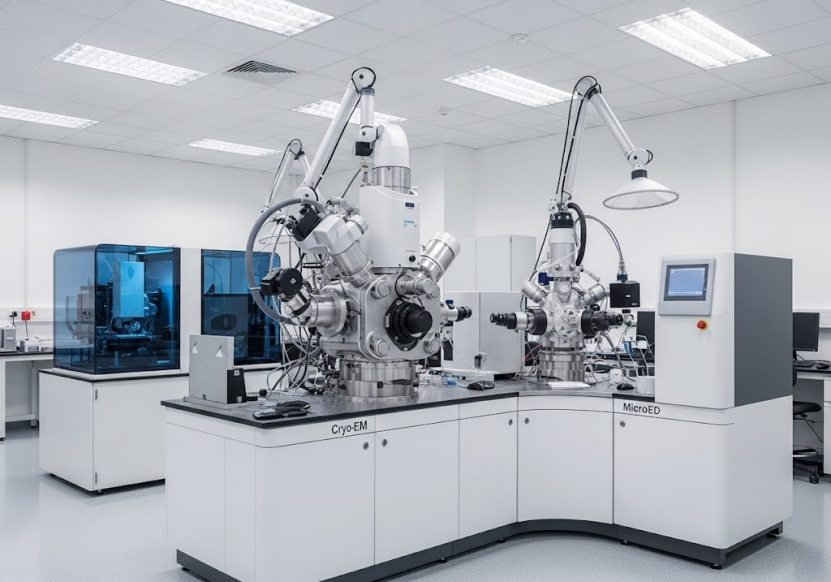
Structural biology plays a pivotal role in understanding biological mechanisms and driving drug discovery. Traditionally, techniques like X-ray crystallography have relied on obtaining large, well-ordered crystals, a significant bottleneck for many challenging targets. The advent of cryo-electron microscopy (cryo-EM) has revolutionized the field, allowing researchers to determine the high-resolution three-dimensional structures of biomolecules from frozen, near-native state samples. However, challenges persist, particularly when samples only yield micro- or nanocrystals.
This is where MicroED (Microcrystal Electron Diffraction) emerges as a powerful complementary technique. By utilizing the strong interaction of electrons with matter, MicroED can provide atomic-resolution structures from crystals orders of magnitude smaller than those required for X-ray diffraction. Recognizing the immense potential of MicroED and the widespread adoption of cryo-EM, ShuimuBio has developed eTasED, an innovative software solution designed to integrate MicroED workflows seamlessly onto standard cryo-EM systems. This integration eliminates the need for dedicated MicroED hardware, making this cutting-edge technology more accessible and efficient for researchers.
This article will delve into the world of cryo electron microscope technology, the power of MicroED, and how ShuimuBio's eTasED software enhances structural biology capabilities by enabling seamless MicroED data collection and analysis directly on existing cryo-EM infrastructure.
The Foundation: Cryo-Electron Microscopy (Cryo-EM)
Cryo-electron microscopy (cryo-EM) is a sophisticated imaging technique that allows for the visualization of biological structures at near-atomic resolution. Unlike traditional electron microscopy that often requires samples to be stained or metal-shadowed, potentially distorting their natural conformation, cryo-EM involves rapidly freezing samples in a thin layer of vitreous ice. This flash-freezing preserves the biological macromolecules in a state close to their native environment, a significant advantage for studying dynamic processes and flexible structures.
The most widely used cryo-EM method is Single Particle Analysis (SPA). In SPA, a solution containing a large number of identical biological macromolecules (like proteins or viruses) is frozen. The microscope then captures thousands or even millions of two-dimensional images of these individual particles randomly oriented within the ice. Powerful computer algorithms are subsequently used to align and process these 2D images, mathematically reconstructing a high-resolution 3D structure of the molecule.
Cryo-EM SPA offers several key advantages:
· It preserves samples in a state close to their native conformation.
· It can capture different structural states or conformations if the molecule is dynamic.
· It typically requires less sample material compared to traditional crystallography.
· It is highly effective for determining the structures of large protein complexes, membrane proteins, and viruses that are difficult or impossible to crystallize.
ShuimuBio is at the forefront of commercial cryo electron microscope services, boasting one of the largest platforms globally with eight 300kV cryo-electron microscopes equipped with high-performance detectors and advanced optics across facilities in Beijing and Hangzhou. This infrastructure, combined with a team of experienced scientists, allows them to offer comprehensive cryo-EM services, including:
· One-stop SPA solutions for a wide range of targets like antibody-antigen complexes, small molecules with targets, PROTACs, membrane proteins (GPCRs, ion channels, transporters), VLPs, and peptides.
· 24/7 machine time service for data collection.
· Cryo-characterization of nanoparticles such as AAV, liposomes, LNPs, and VLPs.
· Negative staining for preliminary sample assessment of homogeneity, shape, and size.
· Proprietary technologies like GraFuture™ graphene grids to address sample preparation challenges such as preferred orientation and low concentration.
ShuimuBio has successfully completed over 400 cryo-EM projects, resolving more than 150 protein structures with resolutions reaching a remarkable 1.8 Å. Their commitment to quality and efficiency is further supported by independently developed AI algorithms and the SMART software series, which accelerate data analysis.
MicroED: Seeing Structures in Tiny Crystals
While SPA is excellent for non-crystalline or single-particle samples, some biological molecules or especially small molecules and peptides may form microcrystals that are too small for standard X-ray diffraction techniques but are suitable for electron diffraction. MicroED (Microcrystal Electron Diffraction) is a cutting-edge technique adapted from traditional electron crystallography that is specifically designed to work with these tiny crystals, often measured in micrometers or even nanometers.
In MicroED, a beam of electrons is directed at a microscopic crystal, and the resulting diffraction pattern is recorded as the crystal is tilted. Because electrons interact much more strongly with matter than X-rays, even a very small crystal can produce a strong diffraction pattern. By collecting diffraction data from multiple orientations, a high-resolution 3D map of the electron density within the crystal can be reconstructed, allowing for the precise determination of atomic positions and the molecular structure.
MicroED has emerged as a powerful tool for:
· Determining the structures of small organic molecules that may not form large crystals suitable for X-ray crystallography.
· Solving structures of peptides.
· Obtaining high-resolution structures of proteins from microcrystalline samples.
This technique is particularly valuable for samples where obtaining larger crystals is challenging or impossible, thereby opening up new avenues for structural analysis.
eTasED: Unlocking MicroED on Your Cryo-EM System
Despite its power, implementing MicroED historically might have involved dedicated equipment or complex setup processes. Recognizing the potential synergy between MicroED and the growing availability of facilities, ShuimuBio developed eTasED.
eTasED is independently developed software that represents a significant advancement in the accessibility of MicroED technology. Its core innovation lies in its ability to enable the application of MicroED techniques seamlessly using conventional cryo electron microscope systems. This means researchers with access to a standard cryo-EM can potentially utilize MicroED without needing to invest in or modify their existing hardware.
The seamless integration offered by eTasED is a major advantage, allowing researchers to switch between SPA and MicroED workflows on the same instrument. This flexibility is invaluable when dealing with diverse samples, some of which might be amenable to SPA while others only yield microcrystals suitable for MicroED.
Key benefits of using eTasED for MicroED on a cryo electron microscope system include:
· Seamless Integration: eTasED software works with standard cryo-EM systems, requiring no additional hardware modifications.
· Enhanced Efficiency: By streamlining the data collection process on familiar cryo-EM platforms, eTasED improves the efficiency of MicroED experiments.
· Increased Accuracy: The software is designed to contribute to higher accuracy in the data analysis process for MicroED.
· Versatile Application: eTasED can be applied to obtain high-resolution structures from challenging samples, including small molecules, peptides, and proteins, offering structural insights down to atomic resolution.
· Proven Success: ShuimuBio has demonstrated significant success using eTasED, achieving resolutions as high as 0.6-1.0 Å for various samples and successfully completing over 80% of their MicroED projects. Examples of structures solved using eTasED include Proteinase K (1.50 Å), the peptide FUS LC RAC1 (0.65 Å), and the small molecule Acetaminophen (0.65 Å).
By leveraging eTasED, ShuimuBio provides a powerful service for researchers needing high-resolution structural information from samples that are difficult to handle with traditional methods or standard cryo-EM SPA. This capability is particularly valuable in pharmaceutical research and academic structural biology labs working on challenging targets.
Applications of MicroED Enabled by eTasED on Cryo-EM
The combination of MicroED enabled by eTasED and the comprehensive capabilities of a cryo electron microscope platform like ShuimuBio's significantly expands the types of projects that can be tackled.
· Small Molecule Drug Discovery: Determining the precise 3D structure of a small molecule drug candidate or its complex with a target protein is crucial for understanding mechanism of action, optimizing binding affinity, and improving selectivity. For compounds or protein-ligand complexes that only form microcrystals, MicroED via eTasED provides a viable path to obtaining atomic resolution structures, complementing cryo-EM SPA used for larger targets like GPCRs or enzymes. This is particularly relevant for Fragment-Based Drug Discovery (FBDD), where understanding the binding of small fragments to a target protein often requires high-resolution structural data from potentially very small crystals.
· Peptide and Protein Structure Determination: While cryo-EM SPA is excellent for many proteins and complexes, some proteins or peptides may only yield microcrystals. eTasED allows researchers to apply MicroED to these samples using the same cryo-EM infrastructure, achieving high-resolution structures even from low molecular weight proteins (ShuimuBio has solved structures down to 51 kDa using cryo-EM methods) or peptides. This capability is vital for characterizing challenging protein domains, engineered peptides, or complexes that resist forming larger crystals.
· Advanced Materials Science: Although the sources primarily focus on biological applications, MicroED is also a significant tool in materials science for characterizing novel materials at the nanoscale. Its application on a standard cryo-EM via eTasED could potentially open up combined biological/materials science projects if relevant.
· Pharmaceutical R&D: The ability to determine structures from microcrystals rapidly and efficiently using existing cryo-EM facilities accelerates the pace of research and development. Whether it's characterizing a novel therapeutic small molecule, a peptide drug, or understanding challenging protein targets, eTasED on a cryo electron microscope provides a powerful tool in the R&D pipeline.
ShuimuBio's Integrated Approach to Structural Biology
ShuimuBio differentiates itself by offering a comprehensive suite of structural biology services. Their platform integrates protein expression and purification, cryo-EM services (including SPA, machine time, cryo-characterization, negative staining), MicroED solutions powered by eTasED, and traditional crystal structure analysis.
This "one-stop solution" model means that researchers can bring their target (starting from a gene sequence or protein sample) and access a full spectrum of services under one roof. For a challenging target, ShuimuBio's expert team can leverage their experience in membrane protein preparation, explore crystallization conditions for MicroED using eTasED, or pursue SPA using their state-of-the-art cryo electron microscope facility, ensuring the best approach is taken to obtain high-resolution structural data.
Their capabilities extend beyond structure determination to include protein analysis (SPR, BLI, ELISA) and even antibody discovery. This broad expertise makes ShuimuBio a valuable partner for complex biological projects, from basic research to drug development. The stringent quality control, often based on cryo-EM analysis, applied to their protein preparations further ensures sample suitability for downstream structural studies.
Conclusion: Enhancing Structural Insights with eTasED on Cryo-EM
The demand for high-resolution structural information in biology and medicine continues to grow. While cryo electron microscope technology, particularly SPA, has made incredible strides in democratizing structural biology, techniques like MicroED are essential for samples that resist traditional methods or SPA.
ShuimuBio's development of eTasED is a testament to their commitment to innovation in structural biology. By enabling seamless MicroED experiments on standard cryo electron microscope systems, eTasED removes barriers and expands the accessibility of this powerful technique. This integration allows researchers to gain high-resolution structural insights from microcrystalline samples of small molecules, peptides, and proteins, complementing the capabilities of cryo-EM SPA.
Combined with ShuimuBio's world-class cryo-EM platform, expert team, and comprehensive protein services, eTasED positions them as a leader in providing complete structural biology solutions. Whether you have a challenging protein target for SPA or a microcrystalline small molecule, ShuimuBio's integrated platform and innovative technologies like eTasED can accelerate your research and drug discovery efforts, providing the detailed structural information needed for success.
To learn more about eTasED, cryo electron microscope services, and how ShuimuBio can support your structural biology projects, please visit https://shuimubio.com/.