
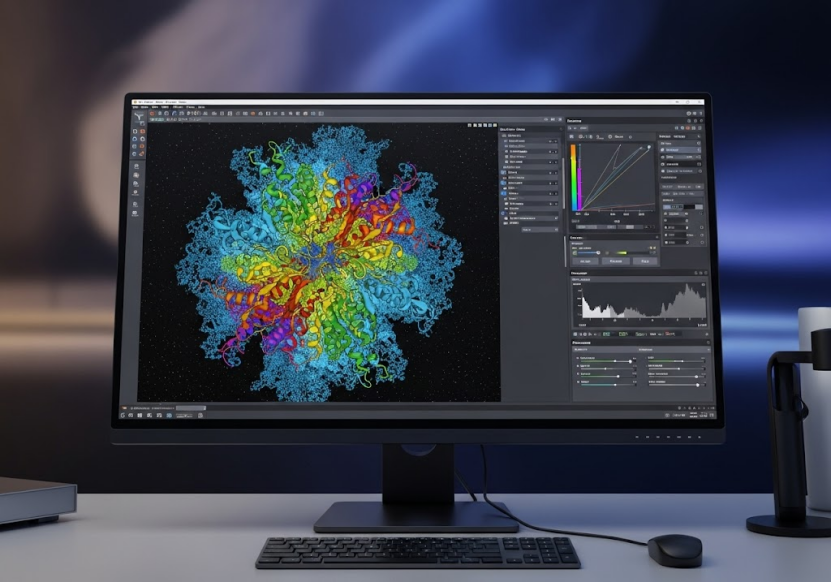
Cryo-electron microscopy (Cryo-EM) has revolutionized structural biology, allowing researchers to determine the high-resolution three-dimensional structures of biological macromolecules that are challenging to study by other methods like X-ray crystallography or NMR. Understanding these structures is crucial for fundamental biological research, as well as for the development of new vaccines and drugs.
At the heart of successful Cryo-EM structure determination lies a complex workflow involving sample preparation, data collection, and sophisticated data processing and model building, which heavily relies on specialized cryo em software. This article will explore the power of Cryo-EM for structure analysis, highlight some key services and capabilities offered by leading platforms like Shuimu Future, and discuss the role of essential cryo em software tools, including the commonly used program Coot, in achieving high-resolution structural insights. To learn more about advanced Cryo-EM services and capabilities, please visit https://shuimubio.com/.
Shuimu Future: A Leader in Cryo-EM Structure Analysis
Shuimu Future, founded in 2017, is presented as Asia's first commercial platform offering Cryo-EM structure analysis services. Their core team comprises experts from life sciences, computational science, IT, and the pharmaceutical industry. The platform leverages deep research and technical expertise from Tsinghua University's structural biology field. Shuimu Future operates one of the world's largest commercial Cryo-EM platforms, equipped with 8 state-of-the-art 300 kV Cryo-EM machines (2 in Beijing and 6 in Hangzhou) dedicated to high-resolution structure determination.
This platform offers a range of comprehensive Cryo-EM services:
· "One-Stop" Single Particle Analysis (SPA) Solution SPA is a powerful technique combining Cryo-EM with computer algorithms to reconstruct high-resolution 3D structures from numerous 2D images of purified biomacromolecules. It's widely used for studying challenging targets like membrane proteins (GPCRs, ion channels, transporters), VLPs, peptides, and small molecules interacting with target proteins. SPA is advantageous because it maintains samples in a near-native state, can capture multiple conformational states, requires minimal sample quantity, and is suitable for determining the structure of heterogeneous protein complexes. Shuimu Future offers a one-stop SPA solution covering the entire process from project consultation, protein expression and purification, negative staining characterization, freezing and data collection, 2D particle picking, 3D reconstruction, model refinement, and data delivery. Their SPA service is supported by experienced scientists and advanced facilities, aiming for ultimate resolution. They have extensive experience with over 200 Cryo-EM projects.
· MicroED Solution Micro-electron diffraction (MicroED) is an advanced technique particularly suited for determining high-resolution structures from microcrystals and nanocrystals, especially for organic compounds, peptides, and proteins. Shuimu Future provides MicroED services, offering free feasibility analysis and risk assessment based on their extensive experience. They highlight their proprietary eTasED software, which allows seamless application of MicroED technology on standard Cryo-EM systems without modifications, improving efficiency and accuracy. Their team has successfully delivered over 80% of MicroED projects with resolutions reaching 0.6 to 1.0 Å. The service is applicable to small molecules, peptides, and proteins in crystalline form.
· Cryo-Characterization This service uses cryo-ultralow temperature technology to maintain samples in their natural state for high-resolution observation and analysis. It's particularly advantageous for studying the structure of proteins, liposomes, exosomes, and material interfaces. Shuimu Future utilizes their self-developed AI Cryo-EM system, NanoSMART, capable of automatically identifying nanoparticle features from images and generating detailed reports. They specialize in characterizing LNPs, liposomes, AAVs, and other viral vectors, providing efficient and accurate services. NanoSMART can analyze various parameters like size distribution, circularity, lamellarity, encapsulation efficiency, and integrity. Example cases demonstrate its effectiveness in identifying liposome and VLP particles.
· Negative Staining & Negative Staining 2D Negative staining is a widely used electron microscopy technique to quickly obtain low-resolution 2D projection images of macromolecules and complexes by staining the background instead of the sample. This provides initial insights into particle size, uniformity, oligomeric state, morphology, concentration, flexibility, integrity, and conformational heterogeneity at a lower cost than cryo-EM. Negative staining 2D refers to analyzing the 2D images obtained via negative staining, particularly for structures arranged in a 2D plane like protein complexes or viral particles. This method is commonly used for initial sample assessment before proceeding to Cryo-EM SPA. It's useful for observing viruses, nanoparticles, organelles, and protein complexes.
· Machine Time Service (24h) Shuimu Future provides 24/7 access to their 300 kV Cryo-EM instruments located in Beijing and Hangzhou for data collection. Their platform includes G3i, G4, and Totem microscopes. They offer convenient and efficient machine time booking and data collection services with a focus on quality. They maintain their instruments meticulously to ensure they operate at optimal performance, aiming for over 330 days of availability per year and a non-fault operating rate exceeding 97%. They support both online remote grid hole selection and selection guided by their scientists.
· GraFuture™, GO & RGO Grids To overcome common challenges in sample preparation like air-water interface damage, severe preferred orientation, high concentration thresholds, and strong background noise, Shuimu Future developed GraFuture™ graphene-supported grids. These grids provide a potential solution for the preferred orientation issue and are suitable for samples with low molecular weight, low concentration, high background noise, and air-liquid interface damage. They offer both Graphene Oxide (GO) and Reduced Graphene Oxide (RGO) versions.
· Protein Preparation and Analysis Services Recognizing that high-quality protein samples are fundamental for successful structure determination, Shuimu Future also offers comprehensive protein services. These include protein expression using various systems (E. coli, mammalian cells, insect cells, cell-free systems), protein sample processing (complex incubation, size exclusion chromatography, Fab cleavage, phosphorylation analysis), purification using methods like affinity, ion exchange, gel filtration, and RP-HPLC chromatography, protein QC (SDS-PAGE, Western blot, mass spectrometry, thermal stability), and protein assay services (SPR, BLI, ELISA). They have particular expertise in membrane protein production and purification. They also offer a list of shelf proteins including GPCRs, ion channels, transporters, and kinases. Shuimu Future's goal is to offer a "one-stop" solution from gene sequence to high-resolution 3D protein structure.
These services, combined with their autonomous AI algorithms and SMART software series, enable Shuimu Future to significantly improve the efficiency and accuracy of structure analysis. They have successfully resolved over 150 protein structures with a best resolution of 1.8 Å using SPA, and even reached 1.4 Å in specific cases, demonstrating their pursuit of extreme resolution. They have experience with small proteins down to 51kDa. They have successfully solved over 300 single particle projects and over 300 protein structures at better than 3.5Å resolution.
Cryo-EM Software in the Broader Workflow
The Cryo-EM workflow involves several key stages: data collection, data processing, model building, and refinement. Each stage requires specific cryo em software tools. While Shuimu Future utilizes its proprietary AI-driven SMART software for data analysis efficiency, the broader field relies on a diverse ecosystem of software.
· Data Processing Software: After collecting millions of 2D images (micrographs), the raw data needs to be processed. This involves motion correction (correcting for beam-induced movement), CTF (Contrast Transfer Function) estimation (correcting for aberrations in the microscope), particle picking (identifying individual molecular images), 2D classification (grouping similar views), 3D initial model generation, 3D classification (sorting particles into different conformational states), and 3D refinement (improving the resolution of the density map). Popular software suites for these steps include Relion, CryoSPARC, FREALIGN, and EMAN2. These programs handle the computational heavy lifting required to transform noisy 2D images into a 3D electron density map.
· Model Building and Refinement Software: Once a high-resolution 3D density map is obtained, the next crucial step is building an atomic model of the protein or complex into this map. This involves fitting known protein structures or building models de novo. Model building and refinement are essential for translating the density map into a biologically meaningful atomic structure.
This is where software like Coot comes into play. Coot cryo em is a widely used program specifically designed for model building, refinement, and validation, particularly popular in both crystallography and Cryo-EM communities. It provides a user-friendly graphical interface that allows researchers to visualize the electron density map, build protein residues, adjust side chains, fit ligands, and identify errors in the model. Coot helps in iteratively improving the atomic model to best fit the experimental density map. While Coot is excellent for interactive model building, other software like Phenix and Rosetta are often used for automated model building and refinement steps, working in conjunction with manual adjustments made in Coot.
· Visualization Software: Tools like ChimeraX, VMD, and PyMOL are used throughout the process for visualizing the raw data, 2D classes, 3D density maps, and the final atomic models. These tools are critical for quality control, understanding the data, and presenting the results.
In essence, a combination of specialized cryo em software is required at each stage of the process, from initial data collection quality assessment to final atomic model building and validation. While automated pipelines are becoming increasingly common, expert manual intervention using tools like Coot cryo em often remains vital for producing the most accurate and complete structural models.
Applications of Cryo-EM and Its Software-Driven Analysis
The structural information obtained through Cryo-EM and analyzed by sophisticated cryo em software has profound applications across various fields:
· Vaccine Development: Cryo-EM helps researchers understand virus structures at near-atomic resolution, providing critical information for vaccine design. It has been instrumental in studying viruses like SARS-CoV-2, influenza, and measles. For SARS-CoV-2, Cryo-EM has been used to resolve the structure of the ACE2 receptor and the complex of the virus's S protein with ACE2, aiding in understanding infection mechanisms and guiding vaccine design. Cryo-EM is also crucial for vaccine quality control, allowing the assessment of particle morphology, size, integrity, and aggregation. It can also help study the interaction between antibodies and vaccine antigens to optimize immunogenicity. When viruses mutate, Cryo-EM can rapidly resolve the structure of new variants, supporting timely adjustments to vaccine strategies.
· Antibody Drug Discovery: In antibody drug development, Cryo-EM is valuable for resolving the high-resolution structures of antibody-antigen complexes, revealing binding mechanisms and epitopes. This structural insight is essential for designing more effective antibody drugs. It also helps in studying the mechanism of action of antibody drugs and optimizing their design by revealing dynamic processes and conformational changes. Cryo-EM's ability to resolve the structure of membrane proteins like GPCRs, which are common drug targets, provides crucial information for developing targeted antibody therapies. The efficiency of Cryo-EM accelerates the drug development process by quickly providing detailed structural information.
· Small Molecule Drug Discovery: Cryo-EM is also significantly impacting small molecule drug discovery. It enables the resolution of target protein structures (like membrane proteins and enzymes), aiding in understanding drug binding sites and informing the design of highly selective and potent small molecule drugs. Studying the interaction mechanism between small molecules and their targets through Cryo-EM can help optimize drug design and improve efficacy. Cryo-EM shows potential in fragment-based drug discovery (FBDD) by revealing interaction details between small molecule fragments and protein targets, assisting in the screening and optimization of drug candidates. Like in antibody development, Cryo-EM's speed accelerates the overall drug discovery process. It also offers unique advantages in studying biased ligands that selectively activate or inhibit specific signaling pathways mediated by targets like GPCRs.
These applications underscore the critical role of high-resolution structure determination, powered by advanced Cryo-EM technology and the suite of cryo em software used throughout the workflow, including tools for data processing, model building like Coot cryo em, and visualization.
Conclusion
Cryo-EM has become an indispensable tool in life sciences and drug development, offering unprecedented insights into the structures and functions of biological macromolecules. Achieving high-resolution structures relies not only on cutting-edge hardware but also on sophisticated cryo em software for data processing, model building, and analysis.
Platforms like Shuimu Future provide comprehensive services, from protein preparation to high-resolution structure determination using Cryo-EM and MicroED, supported by their expertise and proprietary AI-driven software. The broader landscape of cryo em software includes powerful suites for data processing and interactive tools like Coot cryo em for atomic model building and refinement, all of which are essential for extracting maximum biological and pharmacological value from the experimental data.
By combining advanced technology, scientific expertise, and powerful software tools, researchers can continue to push the boundaries of structural biology and accelerate the development of novel therapeutics and vaccines.
To learn more about how cutting-edge Cryo-EM technology and expertise can support your research and development needs, visit https://shuimubio.com/.