Cryoelectron microscopy (Cryo-EM) is a revolutionary technique that has transformed structural biology, enabling scientists to visualize the intricate 3D structures of biological molecules at near-atomic resolution. This powerful method provides unprecedented insights into how proteins, viruses, and other biomolecular complexes function, which is critical for understanding health and disease, and accelerating drug discovery and vaccine development.
At its core, cryo-EM microscopy involves flash-freezing biological samples in a thin layer of ice, preserving their native structures. These vitrified samples are then imaged using an electron microscope. Unlike traditional electron microscopy or X-ray crystallography, Cryo-EM often requires less sample material and can capture multiple structural conformations of flexible molecules.
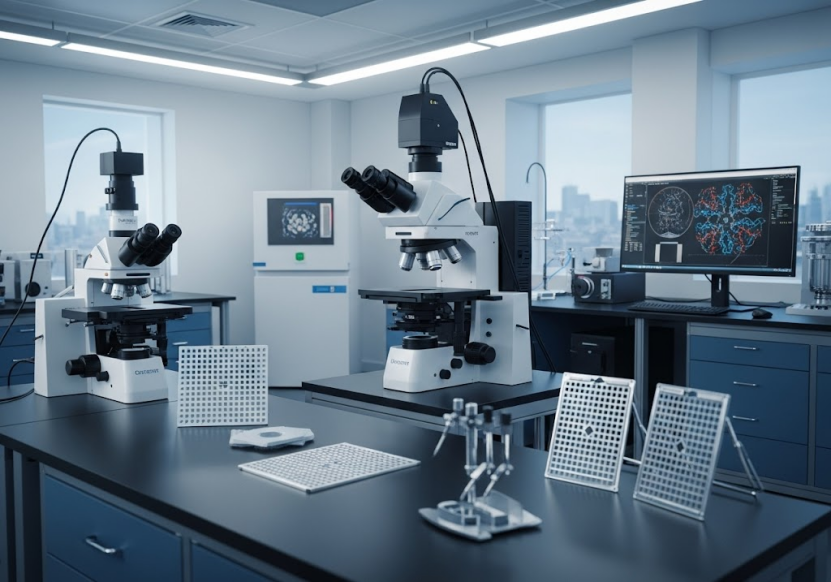
ShuimuBio, founded in 2017 by a core team of life and computational scientists, IT, and pharmaceutical industry experts, was established as Asia's first commercial platform offering cryo-EM structure analysis services. Leveraging deep scientific and technical expertise, they have built an advanced and reliable workflow for experiments and data analysis. With facilities in Beijing and Hangzhou, featuring eight high-end 300kV electron microscopes and comprehensive auxiliary equipment, ShuimuBio operates one of the largest commercial cryo-EM microscopy platforms globally.
Key Cryo-EM Techniques and Services
ShuimuBio provides a range of services utilizing cryoelectron microscopy to address diverse research needs:
1. Single Particle Analysis (SPA): This is a fundamental cryo-EM technique used to determine the high-resolution 3D structure of purified biological macromolecules like proteins, viruses, VLPs, and peptides by processing numerous 2D images of individual particles. SPA is particularly valuable for resolving structures of proteins that are difficult to crystallize. It's widely applied to study complex interactions, including those involving Protacs, membrane proteins (GPCRs, ion channels, transporters), VLPs, peptides, and small molecules with their target proteins. ShuimuBio offers a "one-stop" SPA solution.
2. MicroED (Microcrystal Electron Diffraction): MicroED is a cutting-edge technique that excels in determining high-resolution structures from tiny microcrystals or nanocrystals, particularly useful for organic compounds, small molecule drugs, peptides, and protein structures. ShuimuBio has developed proprietary software, eTasED, to seamlessly apply MicroED using standard cryo-EM systems, boosting efficiency and accuracy. They have a high success rate with MicroED projects, achieving resolutions as fine as 0.6-1.0 Angstrom.
3. Negative Staining & Negative Staining 2D: Negative staining is an electron microscopy technique where the background is stained, allowing the sample structure to be clearly viewed against a dark field. It's a cost-effective way to get preliminary information about sample characteristics like particle size, uniformity, oligomeric state, morphology, concentration, flexibility, integrity, and heterogeneity. Negative Staining 2D focuses on analyzing the 2D arrangement or morphology of structures like protein complexes or viral particles. This service is valuable for initial sample quality assessment before more involved cryo-EM studies.
4. Cryo-Characterization: This service uses ultra-low temperatures to maintain samples in their natural state for high-resolution observation and analysis, especially beneficial for studying proteins, liposomes, exosomes, VLPs, LNPs, and materials. ShuimuBio utilizes their self-developed AI system, NanoSMART, which automatically identifies nanoparticle features from images and generates detailed reports, even enhancing clarity in low-quality images.
Beyond these core cryo-EM microscopy services, ShuimuBio provides essential support, including:
· Machine Time (24h): Offering round-the-clock access to their 300kV microscopes for data collection, backed by skilled technical engineers and platform maintenance to ensure optimal performance. They provide 24-hour response for appointment requests, including an expedited channel.
· GraFuture™: Proprietary graphene grids developed to overcome common challenges in sample preparation like air-liquid interface damage, preferred orientation, high background noise, and issues with small molecule weight or low concentration samples.
· Protein Preparation and Analysis: A full suite of services covering molecular cloning, protein expression (using E. coli, mammalian, insect, or cell-free systems), purification (various chromatography methods), and characterization (SDS-PAGE, Western blot, Mass Spec, SPR, BLI, ELISA). This integrated approach helps mitigate issues from sample transport and ensures high-quality protein samples suitable for structural analysis.
· "One-Stop" Crystal Structure Analysis: For samples amenable to crystallization, ShuimuBio offers X-ray crystallography services, covering the entire process from protein prep to data collection and structure determination.
· Antibody Discovery: Services ranging from antigen preparation and antibody generation (phage display libraries) to antibody expression, purification, and validation (ELISA, SPR, BLI for binding activity and affinity).
Applications of Cryo-EM Microscopy
The high resolution and ability to maintain samples in a near-native state make cryoelectron microscopy invaluable across multiple research fields.
· Vaccine Development: Cryo-EM provides near-atomic resolution structures of viruses, aiding in understanding invasion mechanisms and informing vaccine design. Examples include resolving structures of SARS-CoV-2 components, influenza viruses, and measles virus interactions with neutralizing antibodies. It is also used for vaccine quality control, assessing particle morphology, size, integrity, and aggregation, and helps in quickly analyzing new variant structures.
· Antibody Drug Discovery: Cryo-EM microscopy is crucial for resolving high-resolution structures of antibody-antigen complexes to understand binding mechanisms and optimize antibody design. It helps study the mechanism of action of antibody drugs, especially with complex targets like membrane proteins (GPCRs), and accelerates the drug discovery process by rapidly providing detailed structural information.
· Small Molecule Drug Discovery: Cryo-EM enables high-resolution structure determination of drug targets like membrane proteins and enzymes, aiding in understanding target sites and designing highly selective drugs. It's used to study how small molecules interact with targets, supports fragment-based drug discovery (FBDD) by revealing interaction details, and accelerates the overall process. It is also particularly useful for studying biased ligands and complex drug targets.
ShuimuBio has accumulated extensive experience, successfully completing over 400 cryoelectron microscopy and MicroED projects, resolving over 300 protein structures at better than 3.5Å resolution, and achieving a breakthrough resolution of 1.4 Angstrom. Their expertise covers diverse samples including ion channels, GPCRs, antibody-antigen complexes, and spliceosomes. They have a strong track record of contributing to research published in top-tier international journals.
Why Choose ShuimuBio for Cryo-EM Microscopy?
ShuimuBio combines cutting-edge cryo-EM microscope facilities with a team of top scientists specializing in structural biology, protein science, and computational biology. Their AI-driven platform, including SMART software for data analysis and NanoSMART for nanoparticle characterization, enhances efficiency and accuracy. They are committed to achieving exceptional resolution and have deep experience with challenging targets like membrane proteins. Their "one-stop" service model, from gene sequence to high-resolution 3D structure, streamlines the process and saves time and cost.
ShuimuBio emphasizes rigorous quality control, project management with regular follow-up meetings, and flexible service options. They also maintain a list of readily available "shelf proteins" including key drug targets like GPCRs and kinases.
Cryoelectron microscopy is a powerful tool pushing the boundaries of biological research and drug development. For researchers and companies seeking high-quality structural insights into biological macromolecules, partnering with an experienced provider like ShuimuBio can significantly accelerate discovery.
To learn more about cryo-EM microscopy services or to inquire about a specific project, please visit https://shuimubio.com/.