
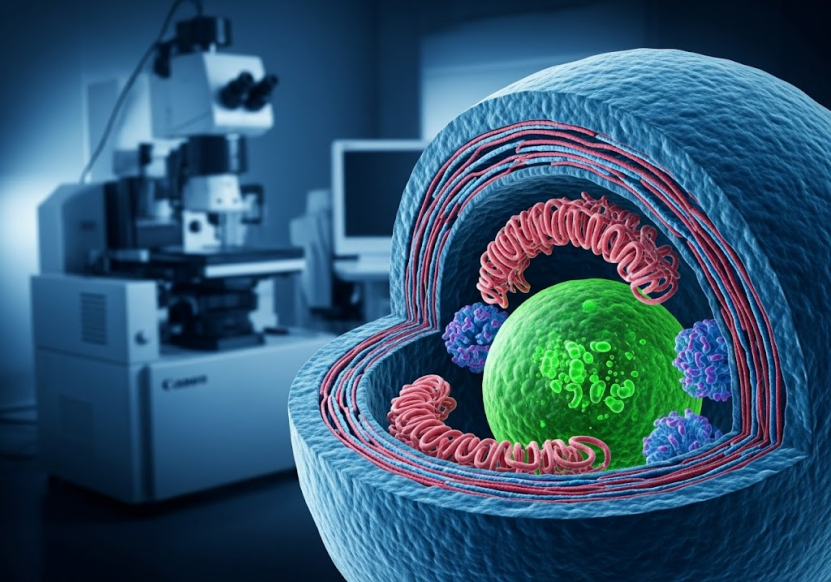
In the rapidly advancing field of structural biology, understanding the intricate 3D architecture of biological molecules is crucial for deciphering their functions and developing new therapeutic strategies. While techniques like X-ray crystallography and Nuclear Magnetic Resonance (NMR) spectroscopy have long been cornerstones, they often require samples to be purified or crystallized, which can alter their native state or exclude large, complex assemblies. This is where the power of cryo electron tomography, often referred to simply as cryo tomography, shines.
Cryo electron tomography is a cutting-edge imaging technique that allows researchers to visualize the three-dimensional structures of biological samples, such as cells, organelles, or large macromolecular complexes, in a near-native, hydrated state. Unlike other high-resolution methods, cryo tomography enables structural studies in situ, meaning molecules can be observed within their natural cellular environment without the need for extensive purification or crystallization. This provides unprecedented insights into the spatial arrangement and interactions of cellular components, offering a more complete picture of biological processes.
The Principle of Cryo Electron Tomography
At its core, cryo electron tomography involves taking a series of 2D projection images of a frozen-hydrated sample from different angles. The sample, typically preserved by rapid freezing (vitrification) to prevent ice crystal formation, is placed in a transmission electron microscope (TEM) and tilted incrementally. An image is captured at each tilt angle, creating a "tilt series." These 2D images are then computationally aligned and reconstructed into a 3D volume, or tomogram, revealing the internal structure of the sample in three dimensions.
This process allows scientists to navigate through the reconstructed volume and identify individual macromolecular complexes, viruses, or cellular structures. Subsequent computational techniques, such as subtomogram averaging, can be applied to improve the signal-to-noise ratio and achieve higher resolutions for specific, repeating structures within the tomogram.
Advantages of Cryo Electron Tomography for In Situ Studies
The primary advantage of cryo electron tomography is its unique ability to provide 3D structural information of biological entities in situ. This offers several key benefits:
· Native Environment Visualization: Samples are observed in their cellular context, preserving their native conformation, interactions, and spatial organization.
· Complex Assemblies: Cryo tomography is particularly powerful for studying large, irregular, or heterogeneous macromolecular complexes that are difficult to purify or crystallize.
· Cellular Context: It allows the visualization of how molecules interact with cellular structures like membranes, the cytoskeleton, or other organelles.
· Heterogeneity Analysis: Unlike methods that average over large populations, cryo tomography can capture the structural variability and different conformational states of molecules within a single sample.
While complementary techniques like Single Particle Analysis (SPA) are excellent for determining high-resolution structures of purified, homogeneous molecules, cryo tomography excels at providing the contextual information often lost during purification. The combination of cryo tomography and SPA, where SPA is used to refine the structure of components identified in situ via tomography, represents a powerful hybrid approach in structural biology.
Applications Across Biological Disciplines
Cryo electron tomography has revolutionized studies in various biological fields, providing crucial 3D structural insights into:
· Cell Biology: Understanding the architecture and dynamics of organelles, the cytoskeleton, cell junctions, and host-pathogen interactions.
· Virology: Visualizing the structure of viruses within infected cells, studying viral assembly and budding, and characterizing the interaction of viruses with cellular machinery. Cryo-EM studies of viruses like SARS-CoV-2, influenza virus, ASFV, HHV-6B, and VSV-GP, as well as VLPs, can be subjects for both SPA and tomography.
· Neuroscience: Studying synapses, neuronal morphology, and the distribution of neurotransmitter receptors and channels.
· Microbiology: Investigating bacterial and archaeal cell envelopes, flagella, pili, and intracellular structures.
· Drug Discovery: Visualizing drug targets in situ and understanding how drugs affect cellular structures.
Challenges in Cryo Electron Tomography
Despite its power, cryo tomography presents several technical challenges. Sample preparation, particularly for thicker samples like whole cells, is complex and often requires techniques like focused ion beam (FIB) milling to create electron-transparent lamellae. Acquiring high-quality tilt series is demanding due to the sensitivity of biological samples to electron beam damage (radiation damage). Furthermore, resolving individual molecules within a dense cellular environment and achieving high resolution throughout the entire tomogram remain active areas of research and development.
Bridging Techniques: From Sample Prep to 3D Reconstruction
Success in any cryo-EM experiment, including cryo tomography, relies heavily on meticulous sample preparation and advanced imaging capabilities. The journey from a biological question to a 3D structure often involves multiple steps.
Initial characterization of purified components or understanding the behavior of samples is vital. Techniques like Negative Staining Electron Microscopy can provide rapid, low-resolution insights into particle morphology, size, and homogeneity. This is particularly useful for assessing sample quality before embarking on more resource-intensive cryo-EM experiments.
Protein preparation is a foundational step for many structural studies, whether the target is eventually studied in isolation via SPA or as part of a complex in situ via cryo tomography. The sources describe comprehensive protein preparation and analysis services, including various expression systems (E. coli, mammalian, insect, cell-free), purification methods (affinity, ion exchange, gel filtration, RP-HPLC), and protein characterization techniques (SDS-PAGE, Western blot, mass spectrometry, thermal stability, solubility, SPR, BLI, ELISA). These services ensure high-purity, homogeneous protein samples crucial for successful structural studies, including those that might inform in situ work or involve reconstituting complexes for tomography.
Furthermore, cryo-characterization services for specific particle types like AAV, liposomes, LNPs, and VLPs are valuable. For example, characterizing the size distribution, morphology, and integrity of viral vectors or drug delivery nanoparticles using cryo-EM is directly relevant to both SPA and potential cryo tomography studies aiming to see how these particles interact with or are internalized by cells. The NanoSMART system exemplifies AI-driven tools for analyzing such nanoparticles.
Advanced Facilities and Expert Capabilities
Performing high-quality cryo electron tomography, like other advanced cryo-EM techniques, requires state-of-the-art equipment and experienced personnel. Founded in 2017, the company possesses a large commercial cryo-EM platform with multiple 300kV cryo-electron microscopes in Beijing and Hangzhou. While these are primarily described in the context of providing machine time and SPA services, such high-end microscopes are also the foundation for cryo-tomography experiments.
The importance of expert teams cannot be overstated. Their cryo-EM center is staffed by seasoned cryo-EM scientists and professional technical engineers responsible for the daily operation and maintenance of the facilities. This depth of expertise is critical for the challenging aspects of cryo tomography, including sample preparation (especially for cellular samples), data acquisition (optimizing tilt series parameters), and advanced 3D reconstruction and analysis.
Moreover, the development and application of advanced software, particularly those leveraging Artificial Intelligence (AI), are key to improving efficiency and accuracy in cryo-EM data processing. The sources mention independent AI-driven platforms like the SMART software series for enhancing data analysis efficiency, NanoSMART for nanoparticle analysis, and eTasED for MicroED data processing. While these tools are described for SPA or nanoparticle characterization, the principle of using AI for particle picking, alignment, and reconstruction is generally applicable across cryo-EM modalities and represents a significant technological advantage that could potentially be applied to cryo tomography workflows for subtomogram averaging.
The "one-stop" solution approach highlighted in the sources, covering services from protein expression and purification to structural analysis, demonstrates an integrated workflow that supports comprehensive structural biology projects. This kind of integrated service is valuable for complex projects that might combine different techniques, including potentially sample preparation or characterization steps that feed into a cryo tomography study.
The Future of Cryo Electron Tomography
As technology continues to evolve, improvements in electron detectors, microscope stability, automated data acquisition software, and computational reconstruction algorithms are pushing the boundaries of cryo electron tomography. The ability to study biological structures in their native context with increasing resolution makes cryo tomography an indispensable tool for cell biology, drug discovery, and understanding complex biological mechanisms.
While the provided sources primarily detail services focused on Single Particle Analysis, MicroED, negative staining, and related protein services, the underlying principles of cryo-EM, the advanced facilities, the experienced scientific team, and the integrated "one-stop" approach described are highly relevant to the broader field of structural biology, which includes cryo electron tomography. These capabilities position a structural biology service provider well to tackle the challenges and opportunities that cryo tomography presents.
To learn more about state-of-the-art structural biology services, including advanced cryo-EM techniques and comprehensive support from sample preparation to high-resolution structural analysis, please visit:
https://shuimubio.com/
Discover how advanced cryo-EM, including techniques that provide 3D structural insight in situ like cryo electron tomography, can accelerate your research.